

Symposium
Towards a Decentered History of Dance
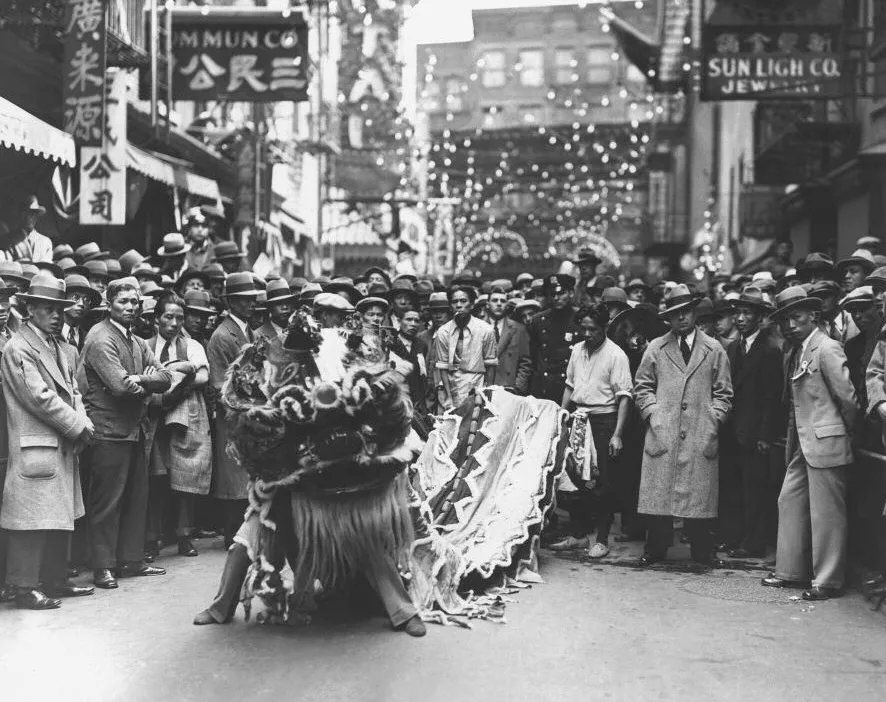
Danse du dragon devant le Hip Sing headquarters sur Pell Street, Chinatown, New York, 27 avril 1931
© Agence Acme
10 > 06.12.21
Conservatoire national supérieur de musique et de danse de Lyon, École normale supérieure de Lyon, Usines Fagor – Lyon
-
06.10
13:30
-
06.11
09:30
-
06.12
09:15
How is history moved, reconfigured, stimulated, by current research on dance? In connection with the publication of A History of Dance in the West (Ed. Le Seuil, Sept. 2020), this international conference aims to extend questions addressed by scholars’ contributions to the book, as well as to generate entirely new dialogues via various acts of “decentering” dance historical scholarship. The polysemic notion of decentering is here understood as an invitation to reevaluate theoretical models, methods, approaches and historiographies of dance.
One idea for a choreographic inspiration for the decentering process is Alwin Nikolais’s 1970 experiments and development of a “travelling center”. For Nikolais, decentering the dancing body provided emancipation and an opening up of the body’s expressive forces, especially in relation to a heritage of codified, hierarchical methods of organizing the body in dance training. Just as Nikolais experimented with a multiplicity of impulses and a polyfocality in space and time, this transperiod conference Towards a Decentered History of Dance hopes to valorize and initiate new ways for researchers to modulate their viewpoints (geographically, through time periods, aesthetics, genres, ethics as well as in relation to both artists and audiences of dance) concerning the history of embodied movement, that is to say, both theatrical as well as social dance practices.
Decentering is thus understood as an intellectual process of deconstruction, in which “moving the center” is a means to decolonize and reorient research perspectives, theoretical notions and methods by which dance practices and cultures have historically been legitimized or ignored (“center vs. periphery”, “capital vs. province”, “noble/savant vs. common/popular”, “occidental vs. oriental”, “high art” or theatrical dance vs. “folklore” or “ethnic dance”). Decentering the dance historian’s perspective is a theoretical and methodological gesture requiring an effort of reflexivity and a certain willingness to take risks. This is particularly pertinent where deconstructing hierarchies, reconceptualizing categories, reinventing and redefining sources and methods is concerned. Our intention is to generate a safe space for new knowledge and scholarship emerging from a decen-tered state of potential imbalance. Conceptualizing how people from different regions of the world relate to and have related to one another in the past via dancing and via movement experiences like Nikolais’s “travelling center” will hopefully allow new research in dance history to resonate with the various intellectual and corporeal imperatives to “move the center” that have been challenging a variety of fields in the social sciences and humanities.
This international conference, Towards a Decentered History of Dance, organized with the support of the Lyon Dance Biennale, the CN D Centre national de la danse the Con-servatoire National Supérieur Musique et Danse (CNSMD) of Lyon, and the École Normale Supérieure (ENS) of Lyon, is dedicated to all dance researchers and seeks particularly to highlight the contributions of emerging scholars and doctoral students.
Credits
Scientific committee
Adrien Belgrano
École des hautes études en sciences sociales
Pauline Boivineau
université d’Angers
Adeline Chevrier-Bosseau
université Clermont Auvergne
Federica Fratagnoli
université Côte d’Azur
Yosef Garfinkel
Hebrew University of Jerusalem
Patrick Germain-Thomas
Chambre de commerce et d’industrie Paris Île-de-France
Marie Glon
université de Lille
Michael Houseman
École pratique des hautes études
Sylvie Jacq-Mioche
historienne de la danse
Sergey Konaev
State Institute of Art Studies, Moscow
Hélène Marquié
université Paris-8 Vincennes – Saint-Denis
Geraldine Morris
University of Roehampton, London
Gerald Siegmund
Justus-Liebig Universität, Giessen
Supports
This symposium is organized with the support of Biennale de la danse de Lyon, le Conservatoire national supérieur de musique et de danse de Lyon, l’École normale supérieure de Lyon, le CN D Centre national de la danse.
And with the support of laboratoires Lettres, langages et arts (UT2J, LLA CREATIS) à Toulouse (Marie-Hélène Garelli), « Héritages et constructions dans le texte et l’image » (HCTI EA4249), université Bretagne Sud à Brest (Marie-Hélène Delavaud-Roux), LabEx ICCA, Centre de recherche sur les liens sociaux (CERLIS, UMR 8070), with the contribution of Christine Détrez (ENS de Lyon).
10 > 06.12.21
Conservatoire national supérieur de musique et de danse de Lyon, École normale supérieure de Lyon, Usines Fagor – Lyon
-
06.10
13:30
-
06.11
09:30
-
06.12
09:15
Practical information
10.06
13:30 – 19:00
at Conservatoire national supérieur de musique et de danse de Lyon
11.06
9:30 – 18:00
at École normale supérieure de Lyon
12.06
9:15 – 18:15
at Maison de la danse – Usines Fagor (salle de conférence)
Registrations
https://histoiredanse.sciencesconf.org/?forward-action=index&forward-controller=index&lang=en