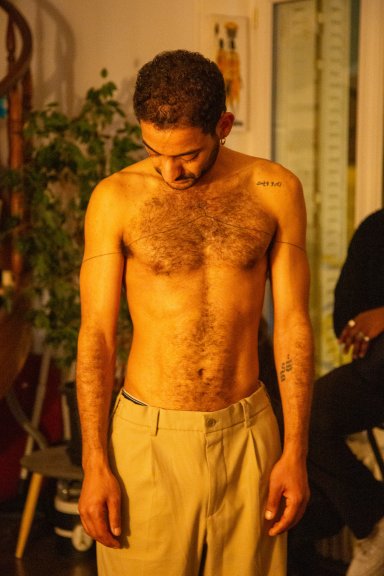
Ommi Sissi brings into play a body subjected to frameworks – medical, social, moral. In this solo piece, Mohamed Issaoui draws on his experience of being hospitalized in the infectious diseases department of La Rabta Hospital in Tunis, and on the year that followed the announcement of his HIV status. A period of upheaval in which the body changes status, social attitudes become judgmental, and shame imposes silence. Ommi Sissi reveals how illness acts as a brutal revealer of norms, taboos, and the logic of exclusion. Traditional Tunisian dances are invoked as displaced forms, diverted from their gender assignments to become tools of emancipation and reappropriation of the body, in a journey that is as spiritual as it is political. In the midst of this ordeal, Issaoui reveals forms of resistance and resilience. Ommi Sissi poses the stage as a necessary space for speaking out, where individual stories become a lever for questioning structural violence, mechanisms of marginalization, and persistent taboos surrounding HIV.
Mohamed Issaoui
Mohamed Issaoui is a Tunisian dancer, performer, and choreographer. Trained in modern literature in Tunisia and in dance at Paris 8 University, he has developed a practice at the intersection of dance, text, and performance that draws on traditional Tunisian dances, which he reinterprets to explore social norms, gender, and sexuality. His first solo piece, Le Déserteur (2017), marked the beginning of an autobiographical body of work in which the body and the intimate become a political space.